concepts
Intended Documentation
Semantic Intelligence
How the Large Intent Model interprets an action into ranked hypotheses and risk signals — and how those signals shape, but never weaken, the authority decision.
Semantic Intelligence#
Semantic intelligence is the interpretation layer of the authority runtime. Before any decision is made, the Large Intent Model (LIM) reads the proposed action and projects structured meaning onto it — what the action is, how confident the interpretation is, and which risk signals matter. The policy engine then decides; LIM does not. Its job is to make the decision better-informed, not to make it.
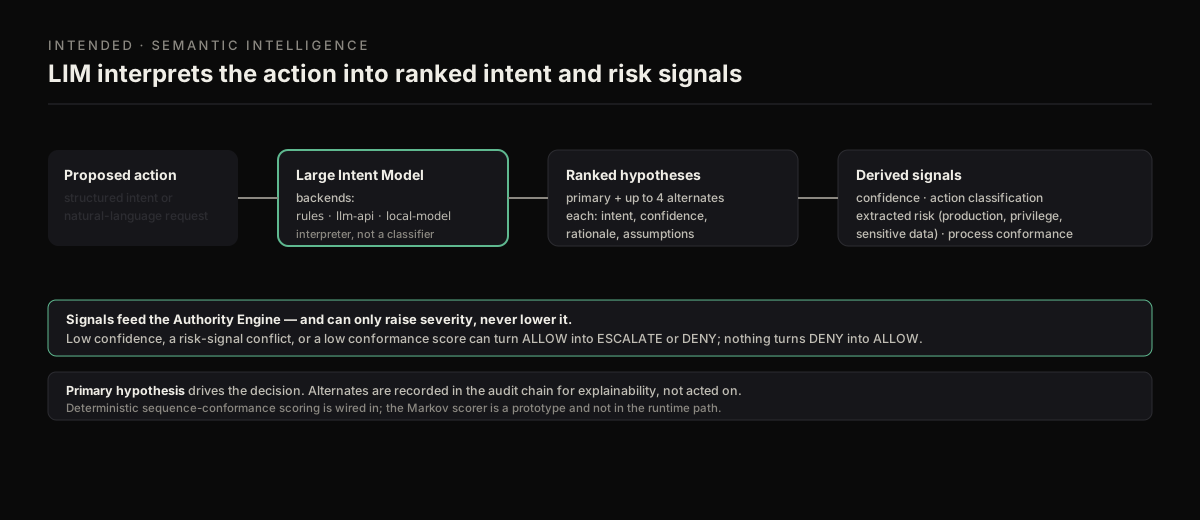
LIM is an interpreter, not a classifier: it emits ranked hypotheses and signals. The primary drives the decision; alternates are recorded for explainability.
An interpreter, not a classifier#
A classifier picks one label and discards the rest. LIM instead emits a ranked set of hypotheses — a primary interpretation plus up to four alternates — each carrying its own confidence, rationale, assumptions, and any missing fields. Only the primary hypothesis drives the authority decision; the alternates are written into the audit chain so a reviewer can see what else the action might have meant. LIM runs on a configurable backend per tenant: a deterministic rules backend, an llm-api backend (the one that produces multiple hypotheses), or a local-model backend.
Derived signals#
From the interpretation, LIM derives the signals the policy engine and your policies can reason over:
| Signal | What it captures |
|---|---|
confidence | How sure LIM is of the primary interpretation (0–1) |
| action classification | The kind of action being interpreted |
touchesProduction | The action affects a production system |
requiresPrivilegedAccess | The action needs elevated privilege |
containsSensitiveData | The action handles sensitive/regulated data |
assumptions / missingFields | What LIM had to assume, and what was absent |
| process-step match & sequence conformance | Whether the action fits the expected business process and order |
These extracted risk signals are the same factors that feed the risk score. The conformance signal comes from a deterministic sequence-conformance scorer (coverage and order against the tenant's process maps).
Signals can only raise severity#
This is the central guarantee of the semantic layer: signals are upgrade-only. They can turn an ALLOW into an ESCALATE or a DENY, but nothing LIM produces can turn a DENY into an ALLOW.
Warning
The semantic layer never grants authority. It can only add caution. Concretely: low interpretation confidence, a conflict between the risk LIM extracts and the risk the caller declared, or a low process-conformance score will push a decision toward escalation or denial — never toward approval.
Representative thresholds applied after policy matching:
- Confidence — below 0.3 denies; below 0.5 (and below 0.85) escalate for review.
- Signal conflict — if LIM detects production/privilege/sensitive-data exposure that the declared risk context understates, the decision escalates.
- Conformance — a sequence-conformance score below the tenant's deny threshold denies; below the escalate threshold escalates.
Scope today#
Info
Accuracy note: the digital (text) interpreter classifies actions into a small, deterministic action vocabulary today — it does not yet classify free-text actions into all 173 categories of the Open Intent taxonomy. The full OI-NNNN classification is produced by the physical structured-goal classifier (see the Physical AI track). Treat broad-taxonomy classification of arbitrary text as roadmap, not current behavior.
Related#
- Authority Runtime Pipeline — where signals feed the decision
- What Is Intended — the system vocabulary
- Intents API — submitting actions for interpretation