api reference
Intended Documentation
API Reference
The Intended runtime API — submit intents for an authority decision, manage authority policies, and pull the tamper-evident audit chain. Every route is fail-closed and tenant-scoped.
API Reference#
The Intended API is the runtime that decides whether a proposed action is allowed to run, mints a single-use proof when it is, and records every step in a tamper-evident audit chain. There is no separate "decision" service and "logging" service to wire together — one request to POST /intent runs the full loop and returns the decision, the signed token, the execution outcome, and the audit head in a single response.
Every endpoint shares three guarantees, enforced in code rather than convention:
- Fail-closed. If the runtime cannot reach a clear decision, it denies. A request that errors anywhere in the authority loop returns
500 AUTHORITY_LOOP_FAILED, never a silent allow. - Tenant-scoped. Your credential resolves to exactly one tenant. Routes that also carry a
tenantIdin the body or path reject a mismatch with403 TENANT_MISMATCH— a hard cross-tenant isolation boundary. - Audited. State-changing operations append SHA-256 hash-chained audit entries as a side effect. You do not opt in.
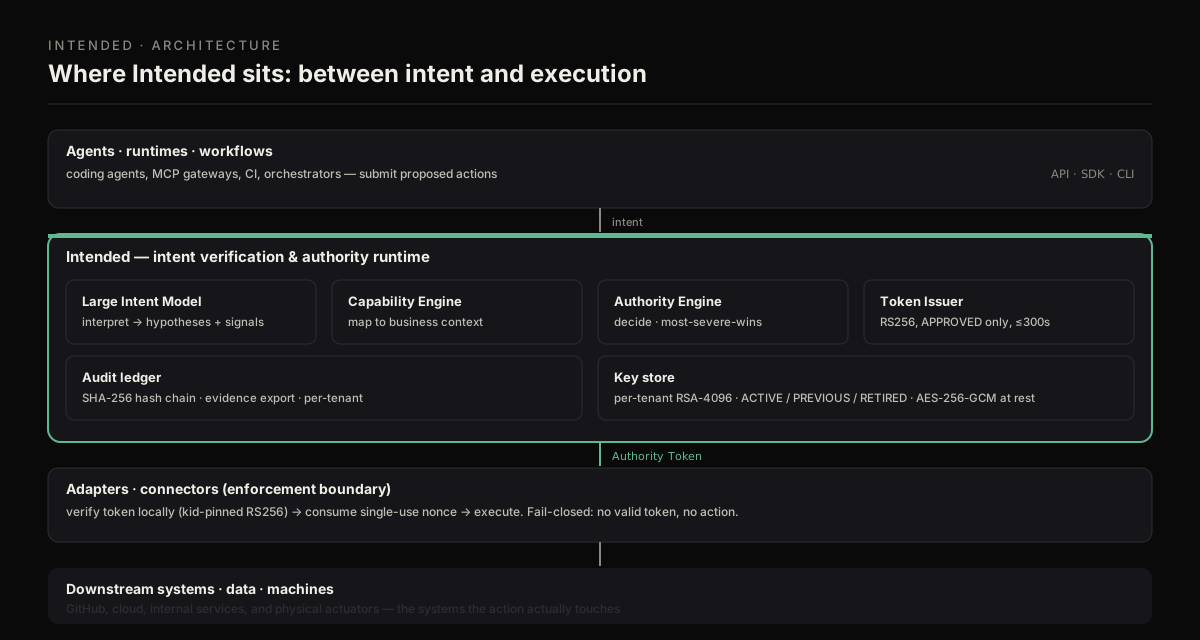
One POST /intent call carries the request through the gate, the authority loop, token issuance, execution, and the audit chain.
Base URL and versioning#
A leading /v1 is accepted and stripped before routing, so /v1/intent and /intent reach the same handler. The paths in these pages omit the prefix.
The endpoints#
| Page | Endpoints | What it does |
|---|---|---|
| Authentication | — | Credential types, the fail-closed gate, headers, scopes, rate limits, and the exact auth errors. |
| Intents | POST /intent, GET /intents, GET /intents/:id, POST /intent/simulate | The core endpoint: submit an IntentRequest, get APPROVED / ESCALATED / DENIED plus a signed decision token. |
| Policies | POST /authority/evaluate, /authority/policies/*, /policy/* lifecycle | Evaluate against authority policy, and draft, review, deploy, and roll back policy. |
| Audit | /tenants/:t/audit, chain verification, evidence bundles, admin exports | Query the hash chain, verify its integrity, and export signed evidence. |
Warning
Two decision vocabularies exist and they are not interchangeable. POST /intent (the runtime loop) returns the legacy enum APPROVED / ESCALATED / DENIED. POST /authority/evaluate (the modern policy engine) returns ALLOW / DENY / REQUIRE_APPROVAL / ESCALATE. Map your client to whichever endpoint you call — do not assume allow/deny on /intent.
Authentication in one line#
Every non-operational route requires a verified tenant context. Present an intended_live_… API key (legacy mrt_… keys are still accepted) and the tenant header:
Only /health, /ready, and /.well-known/jwks.json are public. See Authentication for credential types, scopes, and every auth error.
Error conventions#
- Validation failures return
400with{ "error": "VALIDATION_ERROR", "issues": [...] }(Zod issue array). Some routes use a route-specific code such asINVALID_POLICY_SETorINVALID_AUTHORITY_EVALUATION_REQUEST; theissuesarray is the same shape. - Authorization failures return
401(no/invalid credential) or403(TENANT_MISMATCH,FORBIDDEN,IP_NOT_ALLOWED,MFA_REQUIRED). - Unhandled failures fail closed with a
500and a route-specific code (e.g.AUTHORITY_LOOP_FAILED,AUDIT_QUERY_FAILED).
Info
The committed openapi.yaml is stale in several places — most notably the /intent decision enum, the /execute body, and the physical-token contract — and it omits the /verify/* routes. Where the spec and these pages disagree, the code (and these pages) win.
Next steps#
- Authentication — get a key and pass the gate
- Intents API — submit your first intent
- Quickstart — end-to-end first integration