concepts
Intended Documentation
Authority Token Model
The Authority Token's real structure, Ed25519 signing, per-tenant keys, single-use nonce, 300-second lifetime, and the exact local verification steps and failure reasons.
Authority Token Model#
An Authority Token is the cryptographic proof that a specific action was verified against policy and approved. It is not an identity credential and not an OAuth access token — it is a single-use authorization proof, bound to one intent, that a downstream system verifies locally before it executes. An Authority Token is minted only on an APPROVED decision; DENIED and ESCALATED produce none.
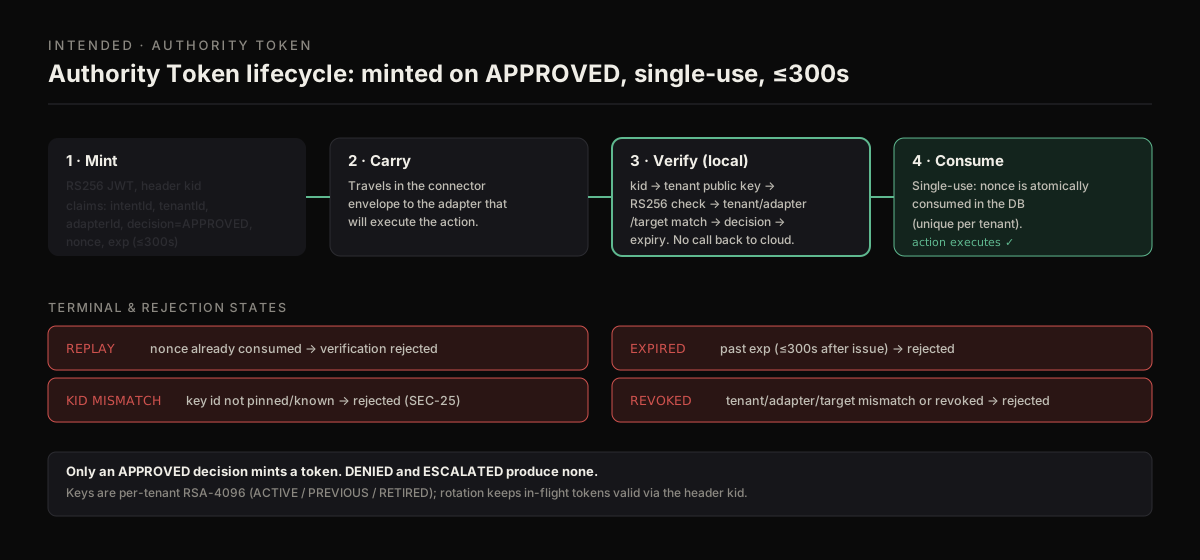
Minted on APPROVED, verified locally, consumed once. Replay, expiry, key-id mismatch, and revocation are all rejected.
Structure#
The Authority Token is an Ed25519 JWT — three base64url sections (header, claims, signature) joined by dots.
Header#
| Field | Value |
|---|---|
alg | EdDSA — Ed25519 (Edwards-curve) signature. |
typ | JWT. |
kid | The tenant's signing-key id. Verifiers use it to select the correct public key; pinning it is mandatory. |
Claims#
The claims bind the token to exactly one intent, tenant, and execution target:
| Claim | Meaning |
|---|---|
intentId | The intent this token authorizes (UUID). |
tenantId | Tenant scope. |
adapterId | The adapter permitted to consume the token. |
adapterTarget | The specific target the adapter will act on. |
targetSystem | The system the action targets. |
proposedAction | The action that was approved. |
decision | Always APPROVED — only approvals mint tokens. |
issuedAt / expiresAt | Validity window (see lifetime below). |
nonce | A ≥32-character random value enforcing single use. |
At signing time the runtime also sets the standard JWT registered claims iss: "intended-authority", aud: <adapterId>, and integer iat / exp.
Lifetime#
Authority Tokens are short-lived by design: the default and the hard maximum lifetime are both 300 seconds (5 minutes). A token cannot be issued with a longer TTL — the signer rejects it. Combined with single-use semantics, this keeps the window in which a leaked token could be misused minimal.
Signing keys#
Each tenant has its own signing key pair; one tenant's key never signs another tenant's tokens.
- Algorithm — algorithm-agnostic, Ed25519 by default (RSA‑4096 / ES256 selectable).
- At rest — private keys are encrypted (AES‑256‑GCM) in the key store and are not exportable.
- Lifecycle — keys are
ACTIVE,PREVIOUS, orRETIRED. Verification acceptsACTIVEandPREVIOUS;RETIREDkeys are excluded. - Rotation — rotating a key issues new tokens under a new
kidwhile in-flight tokens signed by the now-PREVIOUSkey still verify, so rotation causes no downtime.
Verification#
Verification is local: the consumer needs only the tenant's public key for the token's kid, which it can cache and refresh on a schedule. It never calls back to the Intended runtime. The connector SDK's BaseAdapter performs these checks before any action runs; you can also verify directly with @intended/verify.
Select the key by kid
Decode the header, read kid, and load the tenant's public key for it. An unknown or unpinned kid is rejected (TOKEN_KID_MISMATCH).
Verify the Ed25519 signature
A failed signature check is rejected (TOKEN_SIGNATURE_INVALID).
Validate the claims
Assert tenantId, adapterId, and adapterTarget match this execution, decision === "APPROVED", iss/aud match, and the token is unexpired and within the 300s max TTL.
Consume the nonce
The nonce is consumed atomically (unique per tenant). A replay whose nonce is already consumed is rejected. This is what makes the token single-use.
Verifying in code#
Failure reasons#
Verification is fail-closed: any failure rejects the action. Common reasons:
| Reason | Cause |
|---|---|
TOKEN_SIGNATURE_INVALID | Signature does not verify against the key |
TOKEN_KID_MISMATCH | kid not pinned / not a known tenant key |
TOKEN_TENANT_MISMATCH | Token tenant ≠ expected tenant |
TOKEN_ADAPTER_MISMATCH | Token adapter/target ≠ this execution |
TOKEN_EXPIRED | Past expiresAt |
TOKEN_TTL_EXCEEDS_LIMIT | TTL beyond the 300s maximum |
TOKEN_CLAIMS_INVALID | Claims fail schema validation |
Info
The Ed25519 Authority Token described here is the token returned by POST /intent and verified at execution. Intended also uses an internal HMAC-signed permission token for some policy-pack flows; it is not the artifact downstream services verify, and it is not interchangeable with the Authority Token.
Related#
- Authority Runtime Pipeline — where tokens are issued
- Verify a Token — a step-by-step verification guide
- Tenant Trust Boundary — per-tenant key isolation
- Enforcement Lineage — how tokens link into the audit chain