guides
Intended Documentation
OpenShell Operations Runbook
Operate a customer-run OpenShell / NemoClaw runtime governed by Intended — compile and apply policy, monitor decisions, roll back safely, and escalate incidents.
OpenShell Operations Runbook#
Use this runbook to operate a customer-run OpenShell / NemoClaw runtime whose policy is compiled and governed by Intended. The runtime executes in your environment; Intended compiles the sandbox policy and records the audit trail. The boundary between the two is where this runbook focuses.
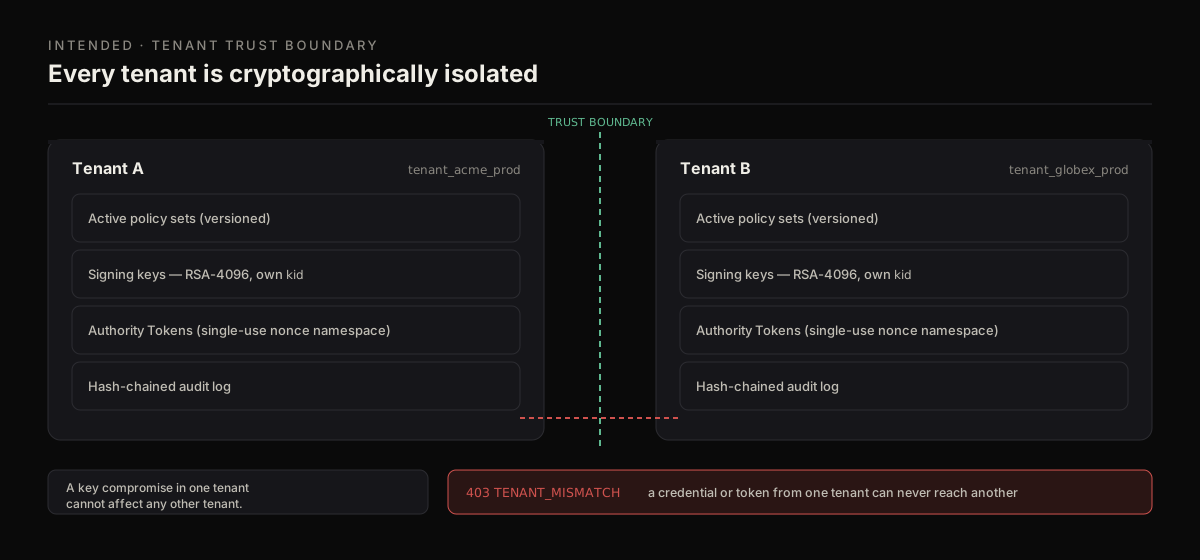
Intended owns the authorization and audit boundary. The operator owns the runtime, its hosts, credentials, and egress.
Preconditions#
Before a rollout, confirm:
- the runtime owner and an approver are identified;
- a staging environment is available;
- the rollback path is validated (you can reapply the last-known-good artifact);
- the operator has reviewed the shared-responsibility boundary below.
Rollout sequence#
Compile the policy artifact
Capture the generated header (profile, risk_posture, inferred_presets) and the file hash in your change record.
Review the inferred scope
Confirm the inferred presets, endpoint hosts/methods, and binary access match what the runtime needs — and nothing more. Pay particular attention to any destination introduced by a runtime or provider baseline rather than your explicit requestedPresets.
Apply in staging, review-first
Apply with the upstream runtime interface and run review-first:
Keep high-risk capability paths in review mode for the first governed runs.
Validate decision-to-audit linkage
For the first governed runs, confirm each decision has a corresponding audit entry and that runtime correlation metadata is present. Stream decisions live while you exercise the runtime:
Promote to production
Promote only after approver sign-off, with the artifact hash and change ticket recorded.
Production checks#
- The policy artifact hash and change-ticket ID are recorded.
- Audit records include runtime correlation metadata.
- Fail-closed paths deny unapproved high-risk actions (a denied action returns no token, so the runtime cannot act).
- The escalation flow works for blocked or denied actions.
Rollback protocol#
- Reapply the last-known-good policy artifact (
openshell policy set <previous>.yaml). - Switch runtime-sensitive capabilities back to review mode.
- Pause high-risk connector paths until the drift is resolved.
- Open an incident review and attach the decision and audit evidence (export with
intended audit-export --tenant <id> --intent <intentId>).
Incident escalation#
Trigger an incident when:
- policy drift is detected (applied policy diverges from the compiled artifact);
- an unknown destination appears in egress;
- an execution-to-audit mismatch occurs;
- repeated
DENYevents indicate malformed runtime requests.
Include in the incident record:
- the policy artifact hash;
- the runtime environment;
- the relevant decision / correlation IDs;
- the impacted systems and current mitigation state.
Monitoring and evidence commands#
| Goal | Command |
|---|---|
| Live decision stream | intended watch --tenant <id> [--decision DENY] [--min-risk <n>] |
| Query audit entries | intended audit-query --tenant <id> [--correlation <id>] [--event-type <type>] |
| Export evidence for an intent | intended audit-export --tenant <id> --intent <intentId> |
| Inspect a token's claims | intended inspect-token --token <jwt> |
Evidence verification is HMAC with the tenant secret
An exported evidence bundle is integrity-protected with HMAC-SHA256 keyed off the tenant's own stored secret. Verifying it requires possession of that tenant secret — it is tamper-evident, but not publicly or asymmetrically verifiable. State this precisely when you share bundles externally.
Shared-responsibility reminder#
Intended governs the authorization and audit boundary: it compiles the policy, decides each action, and records tamper-evident evidence. Your team owns everything on the runtime side of the boundary — upstream runtime deployment, host hardening, credential handling, and provider-specific operational controls.
Next steps#
- OpenShell Runtime Quickstart — compile and apply a policy
- OpenShell Starter Kit — the in-repo pilot pattern
- Tenant Trust Boundary — the isolation model behind the responsibility split