security
Intended Documentation
Tenant Administration
Tenant-scoped admin endpoints for trust posture, environments, members, and role assignment — exact routes, request/response fields, required permissions, and failure modes.
Tenant Administration#
Tenant administration is the read-and-govern surface for a single tenant's trust boundary. It exposes the tenant's trust overview, its environments, its members, and the ability to change a member's enterprise role. Every endpoint is tenant-scoped and permission-checked, and never returns another tenant's data.
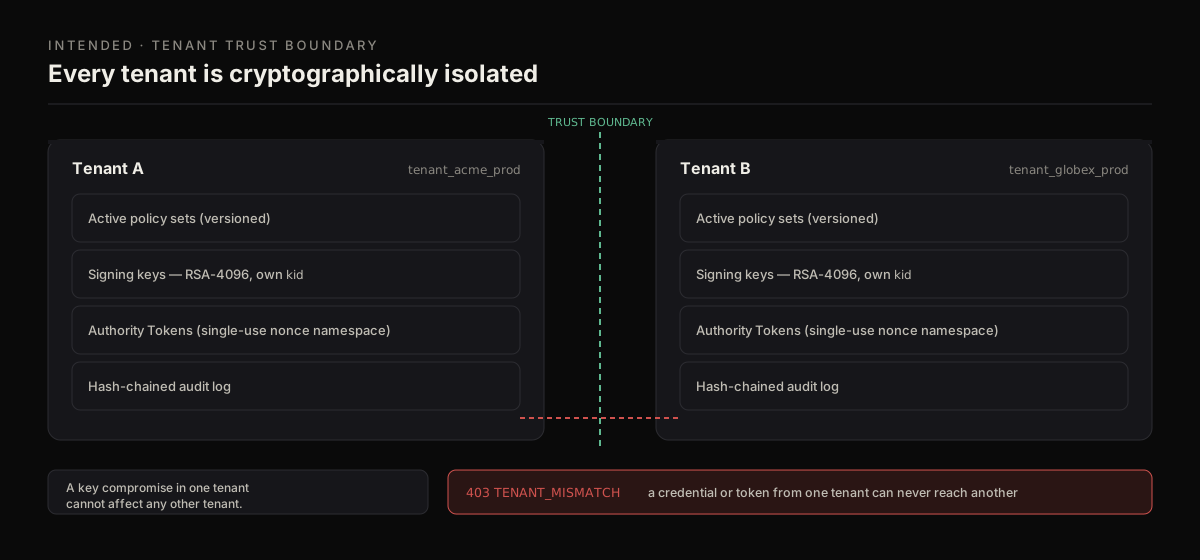
Admin routes operate strictly inside one tenant's boundary. A credential, header, or body tenantId that crosses the boundary is rejected, not silently scoped down.
Authorization model#
All read endpoints on this page require the enterprise permission trust:read, which every enterprise role holds (owner, admin, operator, auditor, reviewer, read_only). Changing a member's role requires members:manage, which only owner and admin hold. See the full matrix in Roles and Token Governance.
The tenant is taken from the authenticated credential, then cross-checked against x-tenant-id and the body/query tenantId. Any disagreement (when the header is present) is rejected with 403 TENANT_MISMATCH.
Read the tenant, trust posture, and workspace#
Three read endpoints return progressively more context. All take tenantId as a query parameter and require trust:read.
Trust overview fields#
The overview object (also returned standalone from GET /admin/trust) contains:
| Field | Type | Meaning |
|---|---|---|
activeMemberCount | int | Active tenant members |
activeApiCredentialCount | int | Active (non-revoked, non-expired) API credentials |
openEvidenceExportCount | int | Evidence exports still queued or processing |
emergencyEventCount7d | int | Emergency control events in the last 7 days |
productionEnvironmentStatus | active · halted · archived · null | Status of the production environment |
openAnomalyCount / openRecommendationCount | int | Open intelligence signals |
trustScore | 0–100 | Heuristic posture score (lowered by a halted production env, recent emergencies, large credential footprint, and open anomalies) |
postureNotes | string[] | Plain-language posture findings |
quickActions | object[] | Suggested next actions, each with its requiredPermission |
trustScore is an operational heuristic
trustScore is a tenant-local posture signal computed from the counts above. It is not a compliance attestation or a certified control score, and it does not map to SOC 2 / ISO / EU AI Act controls — the platform encodes no such control mappings.
Environments#
Environments are returned inline on GET /admin/tenant (and GET /admin/workspace) as environments[]. Each tenant is initialized with three: dev, staging, and production (the last flagged isProduction: true). Each environment record carries status (active · halted · archived), haltedAt / haltedBy (set by emergency controls), and trustNotes.
Members#
Each member record includes:
| Field | Notes |
|---|---|
userId, name, email | Identity of the member |
role | Enterprise role: owner · admin · operator · auditor · reviewer · read_only |
portalRole | The corresponding portal role |
environmentKey | Scope of the role assignment (global by default) |
status | active, etc. |
grantedBy, grantedAt, revokedAt, lastActiveAt | Assignment provenance |
Change a member's role#
Failure modes#
| Status | Code | Cause |
|---|---|---|
| 400 | INVALID_ADMIN_TENANT_QUERY / INVALID_ADMIN_MEMBERS_QUERY / INVALID_ADMIN_MEMBER_ROLE_REQUEST | Missing/invalid tenantId, unknown role, or malformed body |
| 401 | UNAUTHENTICATED_ACTOR | No resolvable actor on the request |
| 403 | TENANT_MISMATCH | x-tenant-id ≠ query/body tenantId |
| 403 | FORBIDDEN (+ permission: "trust:read" or "members:manage") | Role lacks the required permission |
| 403 | ACTOR_NOT_FOUND | Caller is not a member of the tenant and is not an API-key actor |
| 404 | ORG_NOT_FOUND | No organization exists for the tenant |
| 404 | MEMBER_NOT_FOUND | The target user id is not a member of this tenant |
Tenant boundary is strict
x-tenant-id, the query/body tenantId, and the authenticated credential must all resolve to the same tenant. There is no admin path that reads or mutates another tenant's members, environments, or posture.